EV-ready
The maintenance nobody warned you about.
EV ownership is new enough that the 'my dad taught me' knowledge doesn't exist yet. MDG keeps your EV's real schedule in view.
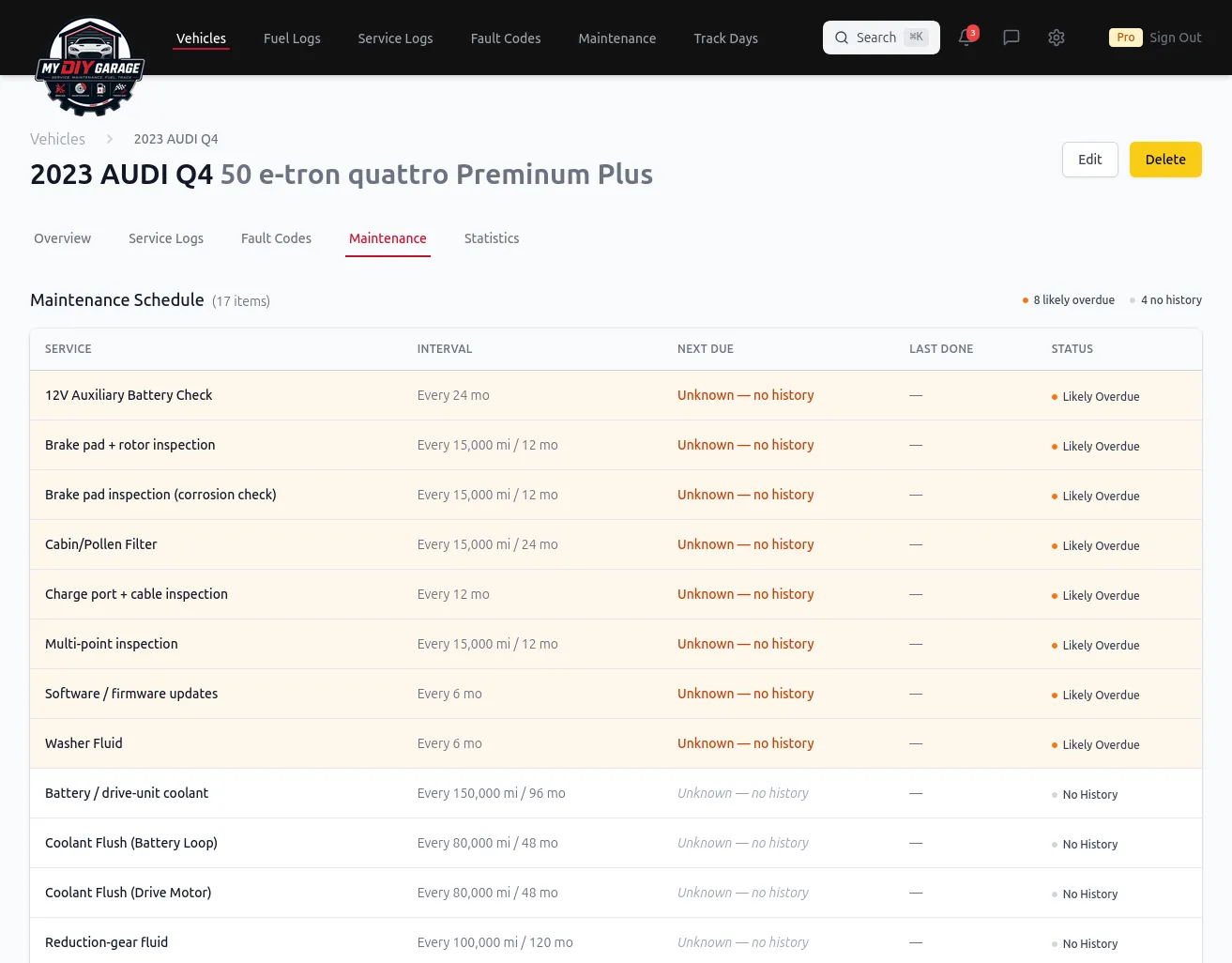
No oil changes doesn't mean no maintenance. Tire rotations, brake fluid, cabin filters, the 12V battery, coolant service — your EV has a real schedule, and MyDIYGarage tracks every part of it.
EV ownership is new enough that the 'my dad taught me' knowledge doesn't exist yet. MDG keeps your EV's real schedule in view.
The assumptions that cost EV owners — and how MyDIYGarage corrects them.
The problem: Skip tire rotations, brake fluid, and cabin filters because 'it's electric' and you'll pay for it later.
How MDG helps: Editable schedules cover the real EV service items, so the maintenance that does exist never gets ignored.
The problem: Almost every EV still has a 12V battery — and a dead one can leave you unable to even open the car.
How MDG helps: Track the 12V battery's age and service so it's a planned replacement, not a roadside surprise.
The problem: Electric drivetrains still set diagnostic codes, and there's far less shared lore on what they mean.
How MDG helps: Log every EV fault code with your notes and resolution, building exactly the history the EV world is still missing.
The big maintenance line items of a gas car — oil changes, spark plugs, timing belts, exhaust — mostly disappear on an electric vehicle. What remains is a real, recurring schedule that's easy to ignore precisely because nobody warns you about it: there's no "my dad taught me" generational knowledge for EVs yet.
MyDIYGarage gives an EV the same treatment as any other vehicle, but with a schedule that fits what it actually is. You track tire rotations, brake fluid, cabin air filters, the 12-volt battery, and coolant for the battery and power electronics — each on an editable interval by mileage, date, or both. When you do the work, you log it the same way you'd log an oil change, building the service history that makes an EV easier to live with and easier to resell.
EVs still set diagnostic trouble codes too, so every fault code you read lives right alongside the maintenance record — building exactly the shared history the EV world is still missing.
Here's the kind of thing that catches EV owners out. Regenerative braking means an EV uses its friction brakes far less than a gas car, so the pads often last much longer — which sounds like less maintenance. But brake fluid still absorbs moisture from the air on the same calendar as any other car, and brakes that are rarely used can actually seize or corrode from disuse.
So the right EV move is to log a brake-fluid flush on a roughly two-to-three-year schedule regardless of pad wear, and to note pad and rotor condition at each tire rotation. In MyDIYGarage you set that interval once; the app reminds you when it's due, and your logged history shows the next owner the fluid was actually kept fresh — a detail a careful EV buyer notices.
EV maintenance is lighter than a gas car's, not absent. These are the items worth putting on an editable schedule; your manufacturer's intervals always take precedence.
| Service item | Typical interval | Why EVs still need it |
|---|---|---|
| Tire rotation | 5,000–8,000 mi | Instant torque and battery weight wear tires faster |
| Brake fluid | 2–3 years | Still hygroscopic; regen means brakes are used rarely |
| Cabin air filter | 15,000–25,000 mi | Cabin air quality, same as any vehicle |
| 12V battery | 3–5 years | Still powers the computers; a dead one can lock you out |
| Battery / electronics coolant | Per manufacturer (often 100,000+ mi) | Keeps the traction battery in its safe temperature range |
| Wiper blades & washer fluid | As needed / yearly | Unchanged from any car |
Notice the one that strands people most: the humble 12V battery. Almost every EV still has one, it powers the door handles and computers, and when it dies you may not even be able to open the car — so it belongs on the schedule as a planned replacement, not a roadside surprise.