Diagnostics
A diagnostic history, not a one-off panic.
Record each fault code, your diagnosis, and the resolution — then watch which codes keep coming back across the life of the car.
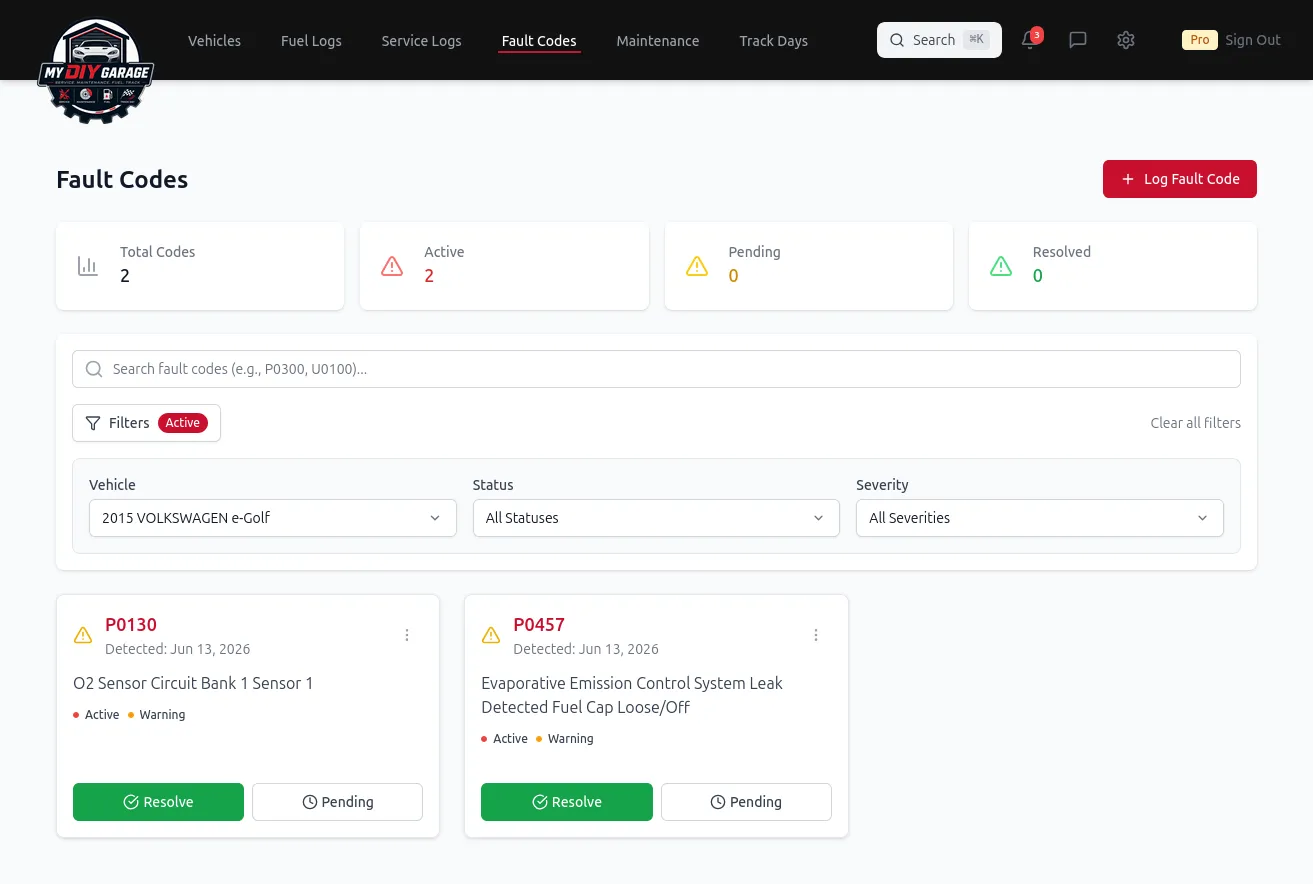
Read codes from the car in the MyDIYGarage mobile app, then log every OBD2 / DTC code with its description, what you found, and what you did — so a check-engine light that comes back is a pattern you can see, not a mystery you re-solve.
Reading codes straight from your car runs in the MyDIYGarage mobile app over Bluetooth OBD2. Logging fault codes, descriptions, your diagnosis, and the full history works everywhere — web, tablet, or phone.
Native iOS and Android apps are coming soon. Today the mobile experience installs as a PWA from your browser; the App Store and Play Store builds are next.
Record each fault code, your diagnosis, and the resolution — then watch which codes keep coming back across the life of the car.
What a code reader alone can't do — and how MyDIYGarage fills the gap.
The problem: You clear a code and a month later it's back — but you've forgotten what it was or what you tried.
How MDG helps: Log each DTC with its description, your diagnosis, and the resolution, so the full story is there when it returns.
The problem: An intermittent fault is the hardest to diagnose — and the easiest to lose track of.
How MDG helps: A running history makes recurring codes obvious, turning 'is it just me?' into a pattern you can act on.
The problem: 'The light's been on sometimes' is a frustrating place for any diagnosis to start.
How MDG helps: Show up with codes, dates, and what you've already ruled out — saving diagnostic time and money.
When your check-engine light comes on, the car has stored a diagnostic trouble code (DTC) — a five-character code like P0420 that points at a system, not a specific broken part. A code reader shows you the code; the moment you clear it, that information is gone. MyDIYGarage keeps it.
In the MyDIYGarage mobile app you read codes straight from the vehicle over OBD2, and each one is saved to that vehicle's history with its description. You then add the part a code reader can't: your diagnosis and your fix — what you found, what you replaced or ruled out, and whether it resolved. (Reading codes from the car is a mobile-app feature; the full history is visible everywhere.)
Over months and years that turns into a real diagnostic record. An intermittent fault that comes back twice a year stops being a fresh mystery each time and becomes a visible pattern — and when you do hand the car to a mechanic, you arrive with codes, dates, and what you've already tried, which is exactly what shortens a diagnosis.
Every DTC follows the same structure, and knowing it tells you where to start before you ever look the code up:
P powertrain (engine/transmission), B body, C chassis, U network/communication.0 is a generic, standardized code; 1 is manufacturer-specific.So P0301 reads as a generic powertrain code for a cylinder 1 misfire. That structure is why a logged history is so useful: once you've diagnosed a P0301 once, your own note is far more valuable than a generic web search the next time it appears.
These are some of the most frequently seen generic powertrain codes. Each points at a system to investigate — not a guaranteed single fix — which is exactly why recording what you actually found pays off.
| Code | Meaning | Where to start |
|---|---|---|
P0420 | Catalyst system efficiency below threshold (bank 1) | Often an O2 sensor or the catalytic converter |
P0300 | Random / multiple cylinder misfire | Plugs, coils, fuel, or vacuum leaks |
P0301 | Cylinder 1 misfire detected | That cylinder's plug, coil, or injector |
P0171 | System too lean (bank 1) | Vacuum leak, MAF sensor, or fuel delivery |
P0128 | Coolant temp below thermostat regulating temp | Usually a stuck-open thermostat |
P0455 | EVAP system large leak detected | Loose or failed gas cap, then EVAP lines |
P0011 | Intake camshaft timing over-advanced (bank 1) | Oil level/quality or a VVT solenoid |
Log the code, then log what fixed it. The second time P0420 appears on that car, your own history — not a forum thread about a different vehicle — is the first thing you check.