Parts Manager
Every part, with the vehicle it belongs to.
Photos, purchase details, and warranty for each part — filed under the car it's installed on, not lost in a glovebox of receipts.
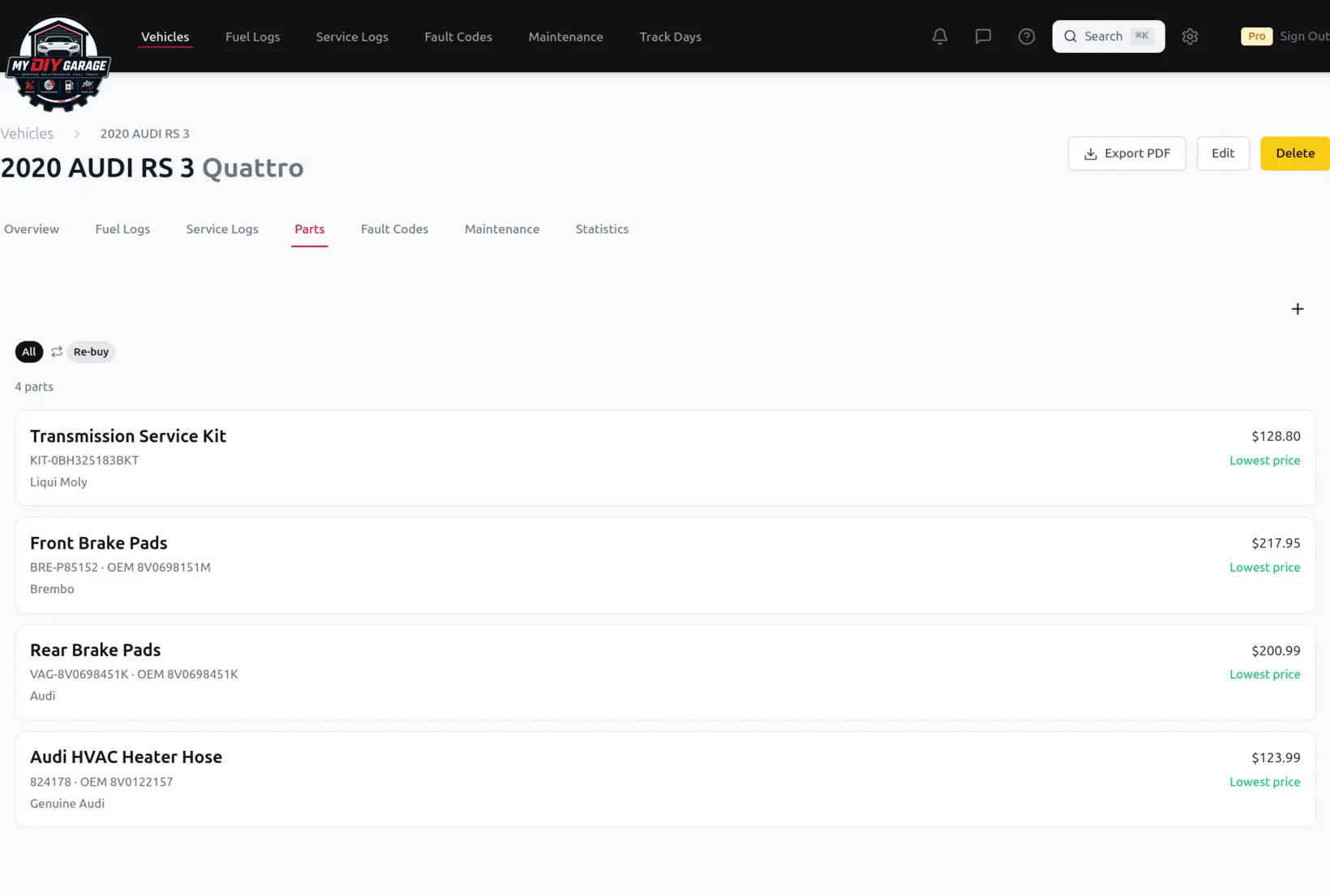
Parts Manager keeps every part you buy with the car it's on. Bought a set of brake pads, a battery, or a box of filters? Log it once — snap up to five photos, record the price, vendor, and date, and note the warranty — and it lives right next to the vehicle it's installed on, so the answer's there the moment you need it.
Photos, purchase details, and warranty for each part — filed under the car it's installed on, not lost in a glovebox of receipts.
Where keeping track of parts by hand falls apart — and how MyDIYGarage fixes it.
The problem: A part number on a receipt doesn't tell you which car it went on, or when — so a year later you're guessing whether those pads are on the truck or the wagon.
How MDG helps: Every part you log is attached to a specific vehicle, so each car carries its own running list of what's been put in it — no guessing, no cross-referencing receipts.
The problem: The best time to find a warranty is the day a part fails — and that's exactly when the paperwork has gone missing.
How MDG helps: Record each part's warranty when you log it — including Lifetime for the parts that carry one — so a warranty claim starts with a date and a vendor instead of a search through old email.
The problem: Parts-store runs add up, but scattered receipts mean you never really know what a car has cost you in parts — or where you found the good price last time.
How MDG helps: Each part keeps its price, vendor, and purchase date, so you can see what you've spent per vehicle and remember exactly where you bought the part that worked.