Fuel & economy
Every fill-up, every trend.
Full-tank logging with automatic economy calculation and monthly summaries — per vehicle, so a thirsty truck never skews your commuter.
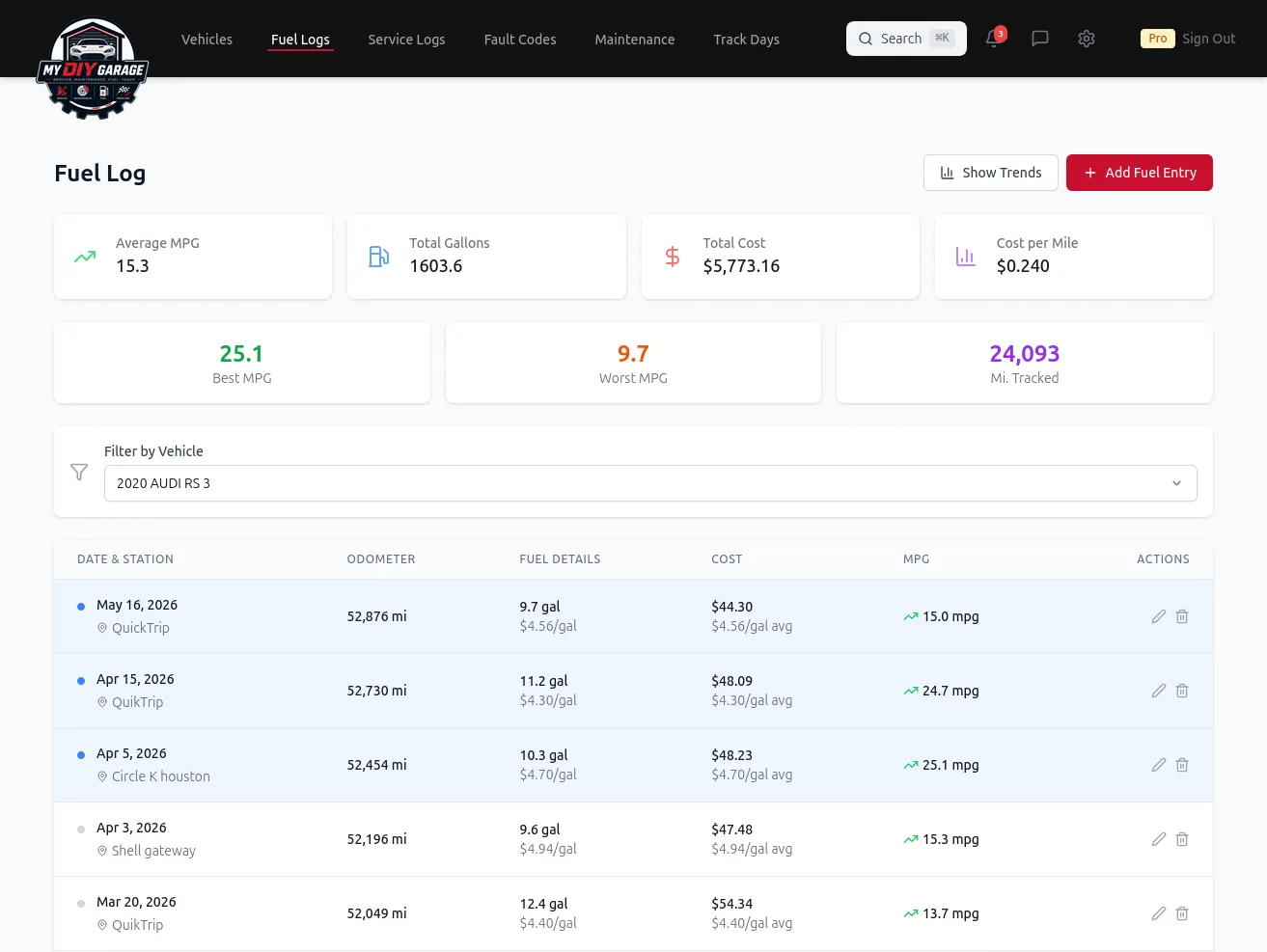
Log every fill-up and MyDIYGarage calculates your actual MPG (or L/100km), monthly fuel cost, and cost per mile — so you see how your car really performs, season by season.
Full-tank logging with automatic economy calculation and monthly summaries — per vehicle, so a thirsty truck never skews your commuter.
Where a notes app or spreadsheet falls short — and how MyDIYGarage closes the gap.
The problem: The trip computer rounds, resets, and lies. You never really know your true economy.
How MDG helps: Full-tank fill-up logging computes your real MPG or L/100km from the actual fuel and distance — no math on your end.
The problem: A slow drop in economy can mean dragging brakes, a failing sensor, or low tires — easy to miss tank to tank.
How MDG helps: Economy trends over time make a gradual decline obvious, so you catch the cause while it's still cheap to fix.
The problem: Fuel is one of the biggest costs of ownership, and most people have no real number for it.
How MDG helps: Monthly summaries and per-vehicle cost tracking show exactly what you're spending — and where.
Your trip computer's MPG readout is an estimate — it rounds, it resets, and it rarely matches reality. The only way to know your true fuel economy is to measure it from the actual fuel you buy and the actual distance you drive, and that's exactly what a fuel log does.
In MyDIYGarage you log each fill-up: the date, the odometer reading, the gallons (or liters) added, and the price. From two consecutive full-tank fills the app calculates your real economy for that tank, then tracks it over time. Because each entry carries a cost, you also get monthly fuel spend and cost per mile — per vehicle, so a thirsty truck never quietly skews your commuter's numbers.
Over time that turns a stack of forgotten receipts into a trend line. A slow drop in economy — from dragging brakes, low tire pressure, a failing sensor, or a dirty air filter — is nearly invisible tank to tank, but obvious on a chart. The fuel log becomes an early-warning system for the car, not just a record of what you spent.
The math behind "real" MPG is simple, and understanding it explains why full-tank fill-ups matter. You measure the distance driven on a tank, then divide by the fuel it took to refill:
The key is filling to the same point each time — a full tank — so the fuel you add exactly replaces the fuel you burned since the last fill. Partial fills break that one-to-one relationship, which is why tank-to-tank full fills give the trustworthy numbers. MyDIYGarage does this arithmetic for you in whichever units you use; you just log the fill.
You fill up to full at 41,200 miles. You drive your normal week, and at 41,540 miles you fill to full again — it takes 11.3 gallons for $42.40. That tank:
| Figure | Calculation | Result |
|---|---|---|
| Distance | 41,540 − 41,200 | 340 miles |
| Real economy | 340 ÷ 11.3 | ≈ 30.1 MPG |
| Cost per mile | $42.40 ÷ 340 | ≈ $0.125 / mile |
| Price per gallon | $42.40 ÷ 11.3 | ≈ $3.75 / gal |
One tank tells you little. Twenty tanks tell you whether 30 MPG is normal for this car — and the moment it starts drifting toward 27, you have an early sign something's worth checking, while it's still cheap to fix.